LSports cuts time-to-merge by 26% and ships 5.3x more deployments after fast-tracking Baz as their LLM-as-a-Judge for code
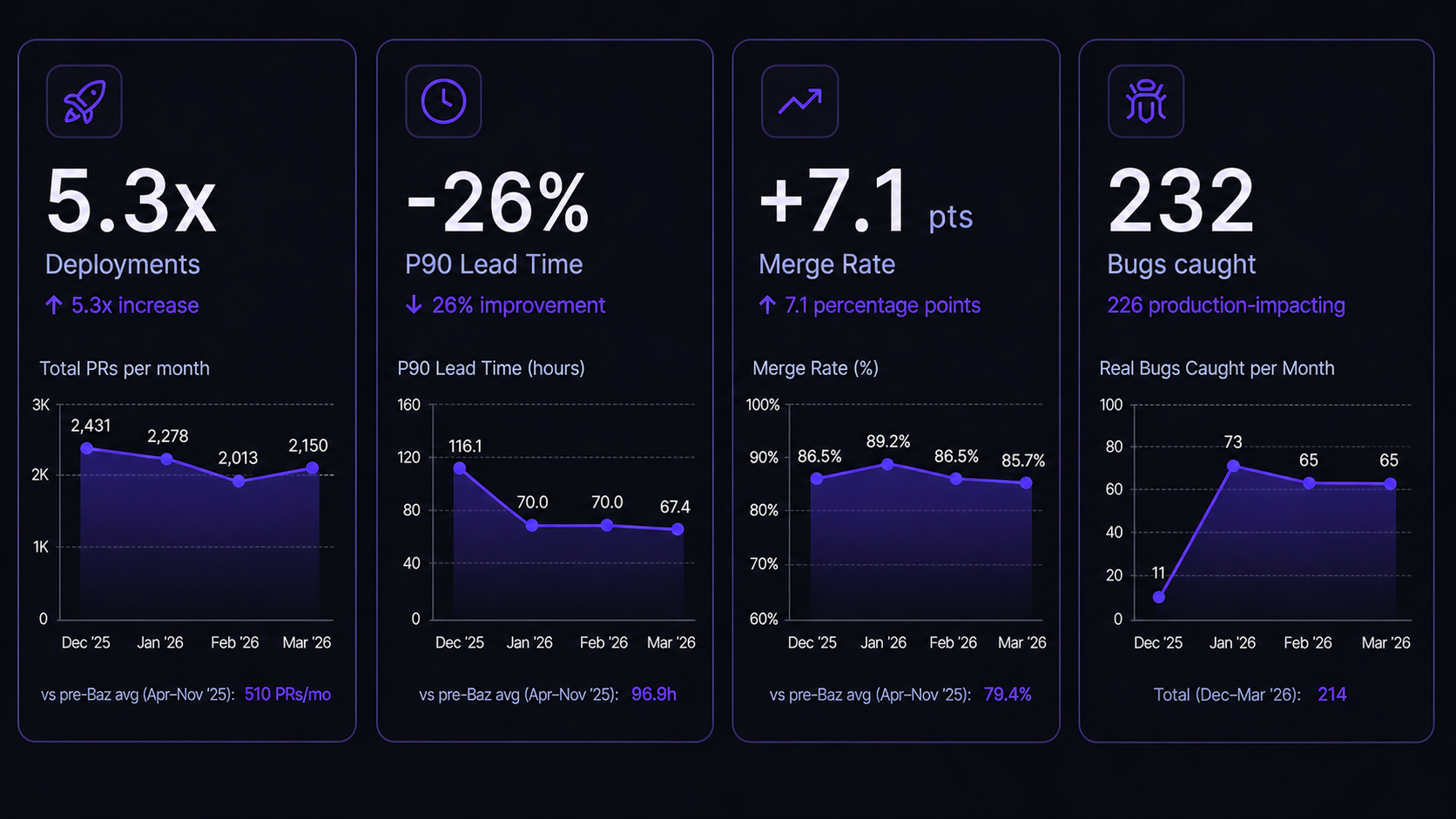
LSports — one of the most technologically advanced engineering organizations in real-time sports data — moved early and decisively on agentic coding tooling, partnering with Baz to deploy an LLM-as-a-Judge layer across 241 repositories. The result: a 5.3x increase in deployment frequency, a 7.1-point lift in merge rate, and a 26% reduction in P90 lead time on their slowest, most complex pull requests. In the same window, Baz caught 232 real bugs — including 226 production-impacting issues and 3 security vulnerabilities.
LSports operates the real-time sports data infrastructure that powers a significant share of the global sports technology ecosystem. The engineering organization is large, distributed, and built around a deeply instrumented, microservices-heavy architecture where shipping velocity, system reliability, and review quality all have to be world-class at the same time. This is exactly the kind of environment where conventional code review breaks down and exactly the kind of environment LSports has spent years engineering to handle at scale.
It is also why, when agentic coding tools began maturing, LSports was among the first engineering organizations of its size to act on them.
The challenge: an LLM-as-a-Judge problem, not a comment-volume problem
LSports did not have a code review problem in the conventional sense. Their engineers are sharp, their processes are mature, and their internal tooling stack runs deeper than most. What they needed was something the rest of the industry was still struggling to articulate: an LLM-as-a-Judge layer for code, an autonomous reviewer that could evaluate pull requests against the bar a senior engineer would set, prioritize what actually mattered, and operate at the speed and scale of a modern, agentically-augmented development workflow.
In short, they did not need more comments. They needed judgment. And they needed it deployed across hundreds of repositories without adding noise, drag, or false positives to a team that was already moving fast.
The solution: Where Baz fit like a glove
Baz was purpose-built for exactly this problem, and LSports recognized the fit immediately. Within weeks of evaluation, the team moved from pilot to full production rollout — one of the fastest enterprise-scale adoptions of an agentic code review platform we have seen.
The shared Slack channel with Baz tells the story of an engineering org that knew exactly what it wanted from the technology. One engineer wrote that "The Baz Reviewer has been a HUGE help," singled out the Severity Indicator as having "saved me a lot of time," and noted that comments were "shorter and much more concise" than anything they had used before. The conversation moved quickly past comment quality and into deeper workflow integration: auto-resolving feedback once it had been addressed, expanding that automation across more repositories, and ultimately opting in at the GitHub organization level.
That is the trajectory of a team that has evaluated, validated, and committed fast.
The impact: throughput and quality, in the same direction
On the same 241 repositories, comparing pre-Baz and post-Baz performance:
Deployment frequency increased 5.3x
Merge rate improved by 7.1 percentage points
P90 lead time fell 26% — from 96.9h to 71.7h on the slowest, most complex PRs
15,700 Baz review comments delivered across the org
226 production-impacting bugs caught before shipping
3 security vulnerabilities caught during review
The P90 number is the one that matters most. P90 is where review bottlenecks pile up, where complex changes stall, where bugs hide. Cutting roughly 25 hours off the slowest tail of the distribution is not the kind of result you get from a tool that just tidies up review comments. It is the kind of result you get when an LLM-as-a-Judge layer is genuinely operating at the level of a senior reviewer, across an entire engineering org, in real time.
Most velocity tools improve speed at the expense of rigor. LSports got both: higher throughput, faster slow-tail merges, and hundreds of real, production-impacting issues caught in the process.
The takeaway
LSports is one of the most technically forward engineering organizations operating at this scale, and they moved on agentic coding tooling faster than almost anyone else in the market. They needed an LLM-as-a-Judge for code. Baz delivered exactly that and the data on 241 like-for-like repositories shows what happens when an engineering org of this caliber gets the right autonomous reviewer at the right time.
In other words - a perfect fit.
Authors: Daniel Netzer, Chief Product and Technology Officer at LSports & Guy Eisenkot, CEO & Co-founder at Baz


.png)