Auto Approve issues a formal PR approval once every Baz comment is resolved and the corresponding fixes are verified against linters and CI. Auto Resolve closes review threads only after the system correlates a verified transform to the original comment and confirms required checks are green. Both features are governed by admin-configurable rules, supported-language lists, and confidence thresholds, and they emit immutable metadata, reverts, and telemetry to help teams reduce manual validation and advance toward an autonomous codebase.
Pull Requests are the unit of collaboration and the place where developer time accumulates. When a PR bundles formatting, lint fixes, small refactors, and design work, human reviewers spend time validating deterministic edits. That manual validation leads to slower merges. The architecture we built treats validation as an empirical problem. Capture the evidence, verify it, and only then take the routine action that humans already expect.
Auto Resolve: close only when the evidence holds
Auto Resolve links fixes to review conversations and closes threads only after a fix addressed the original comment and that all required checks pass. Baz maps thread positions to patch hunks, confirms the correct transformation, and evaluates admin-specified policies before issuing a resolve action. Each resolve is annotated with metadata: the applied commit, CI status at time of resolution, the rule that matched, and an audit link for reproducibility.
Auto-resolve setup
Auto Approve: if all is resolved, then approve
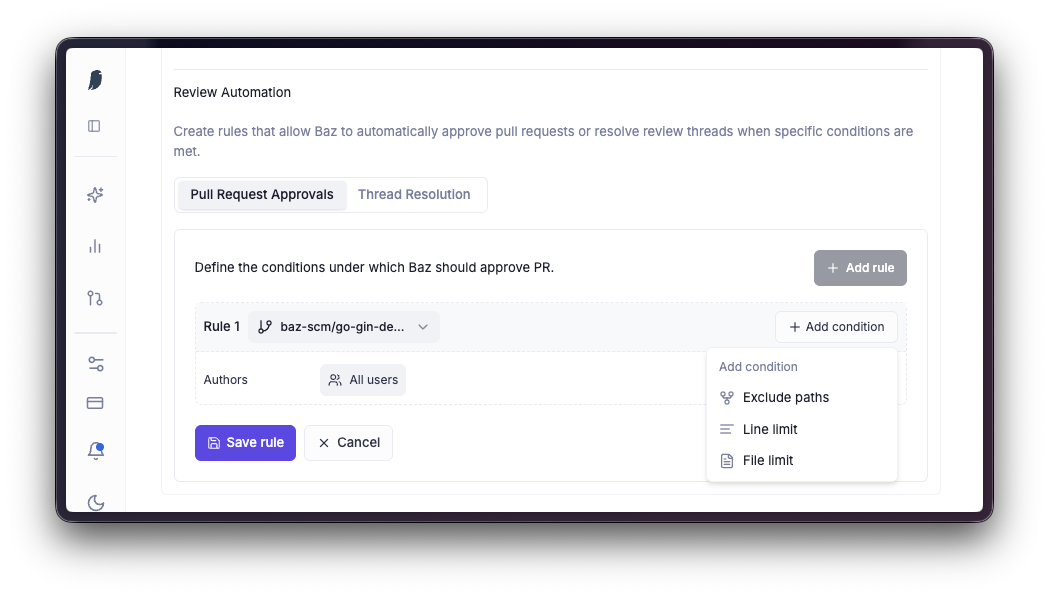
Auto Approve issues a formal PR approval only after every Baz comment on the PR has been resolved and the suggested fixes have been verified. The Reviewer agent and Baz Fixer emit concrete patches or candidate commits and the system correlates each patch to the specific Baz thread it intends to satisfy. Those transforms are validated locally, run through the repository linters and required checks, and evaluated against a configurable confidence threshold. When all Baz comments are resolved and the CI gate is green, Baz posts an approval review that can be counted toward the repository’s required approvals for merge. Admins retain control via org and repo toggles, whitelists, blacklists, and per-author policies, and every automated approval is persisted with immutable metadata linking the approval to the applied commits, the matching threads, and the CI state, plus a one-click revert for safe recovery.
Auto-approval setup
Auto Approve and Auto Resolve are the practical, measured steps along the road to an autonomous codebase. We are converting routine reviewer work into reproducible agent actions that can be verified, audited, and measured. By treating each Baz comment as evidence to be correlated, validated, and recorded, the system turns human intent into machine-verifiable state transitions that can safely be made by software.
Technically, the features establish a rigorous feedback loop. The Reviewer agent and Baz Fixer produce concrete transforms. The system verifies those transforms with local validation, CI and linter gates, and a rule engine that maps fixes to thread positions. Every action is recorded with immutable metadata and a revert path. That makes automation predictable, measurable, and auditable, which are the primitives you need before increasing the scope of what agents are allowed to do.
Operationally, the design creates a trust runway. Telemetry on approvals, resolves, reverts, and false positives gives a quantitative signal for expanding automation. Admin policies and deny lists create safe boundaries while teams gain confidence in the agent’s behavior. Over time the platform can graduate deterministic, local edits to fully autonomous flows, then incrementally take on larger patterns as evidence accumulates. Auto Approve and Auto Resolve are not endpoints. They are repeatable, scientific building blocks for a future where the codebase manages more of its own low-risk churn.



.png)
